Research before writing
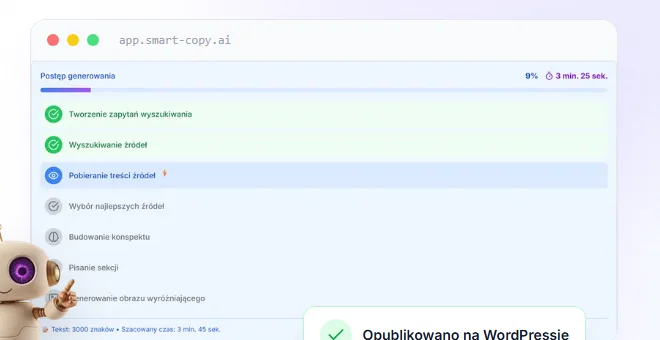
The system drafts queries, searches for sources, fetches their content and keeps the ones that actually add something to the topic. Only from that material does the outline get built.
My own product: you give it a topic and the system finds sources, reads them, drafts an outline, writes section by section, adds an image and publishes the finished post. The same backend serves the panel, the mobile app, a public API and no-code integrations.
The problem
Between the two lie research, an outline, an image, formatting and pasting it all into your site. Generators deliver the middle of that road and leave the rest to the user — and the rest is what takes the most time.
You get paragraphs in a browser window. Publication still needs an image, formatting, pasting it into the site and checking whether it is actually about anything.
Without reaching for material you get text about everything and nothing: plausible-sounding, but without a single number, name or detail that would have required looking anything up.
In longer forms quality drops halfway through, threads start to repeat, and the ending summarizes what has already been said. You have to write in pieces and keep watch over the whole.
These tools sell monthly bundles, while real work looks different: ten texts in one week, then a month of nothing. There you pay for access even when nothing gets written.
The solution
Each step does one thing and passes the result on. It is far more work than a single model call, but it is the only way to get text that stands on its own without edits.
The system drafts queries, searches for sources, fetches their content and keeps the ones that actually add something to the topic. Only from that material does the outline get built.
The text grows piece by piece along an approved outline. That is why the last paragraph holds the level of the first instead of summarizing what was just said.
At the end a featured image is generated, and the finished post can go straight to WordPress. Between the topic and the published article there is no manual step.
Each order is charged against your balance. When a generation fails, the funds come back automatically — no support ticket needed.
From the product
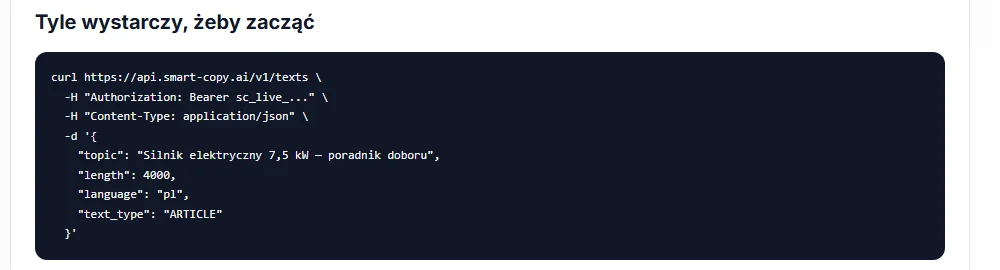
Two views: the process as the user sees it, and the same order placed from someone else's application.
The hard part
What's in it for you
An application with a public API is a different level of commitment than a panel for your own users: endpoints have to stay stable, responses predictable, and errors described so that whoever is on the other side knows what to do. Smart-Copy went down that road together with no-code integrations and a plugin for someone else's system.
If you are thinking about a product that machines should be able to use too — or about wiring an existing tool into whatever your team already works in — write me how it should work.
Related services
Smart-Copy is a web application with a public API and no-code integrations. Below, the rest of what I do for companies, with starting prices.
Let's talk
Describe what it should do and what needs to connect to it. I'll reply with how I'd split it into stages, what a public API requires and roughly what maintenance would cost.