I design and build online stores from scratch: the look, the
descriptions, payments, shipping. I build them so the buyer quickly
finds what they came for and reaches the order in a few steps. After
launch I keep running the store and refine what brings in sales.
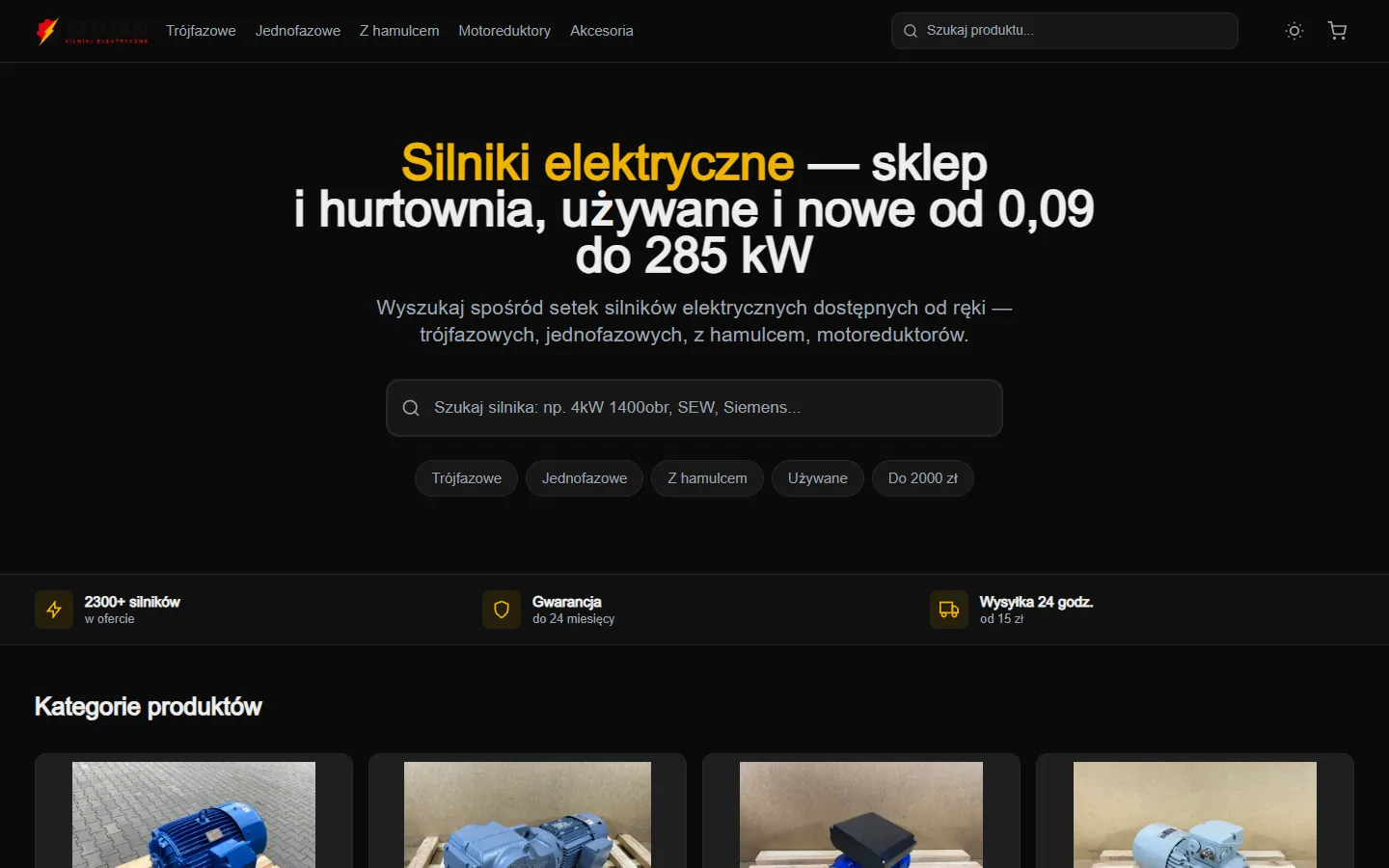
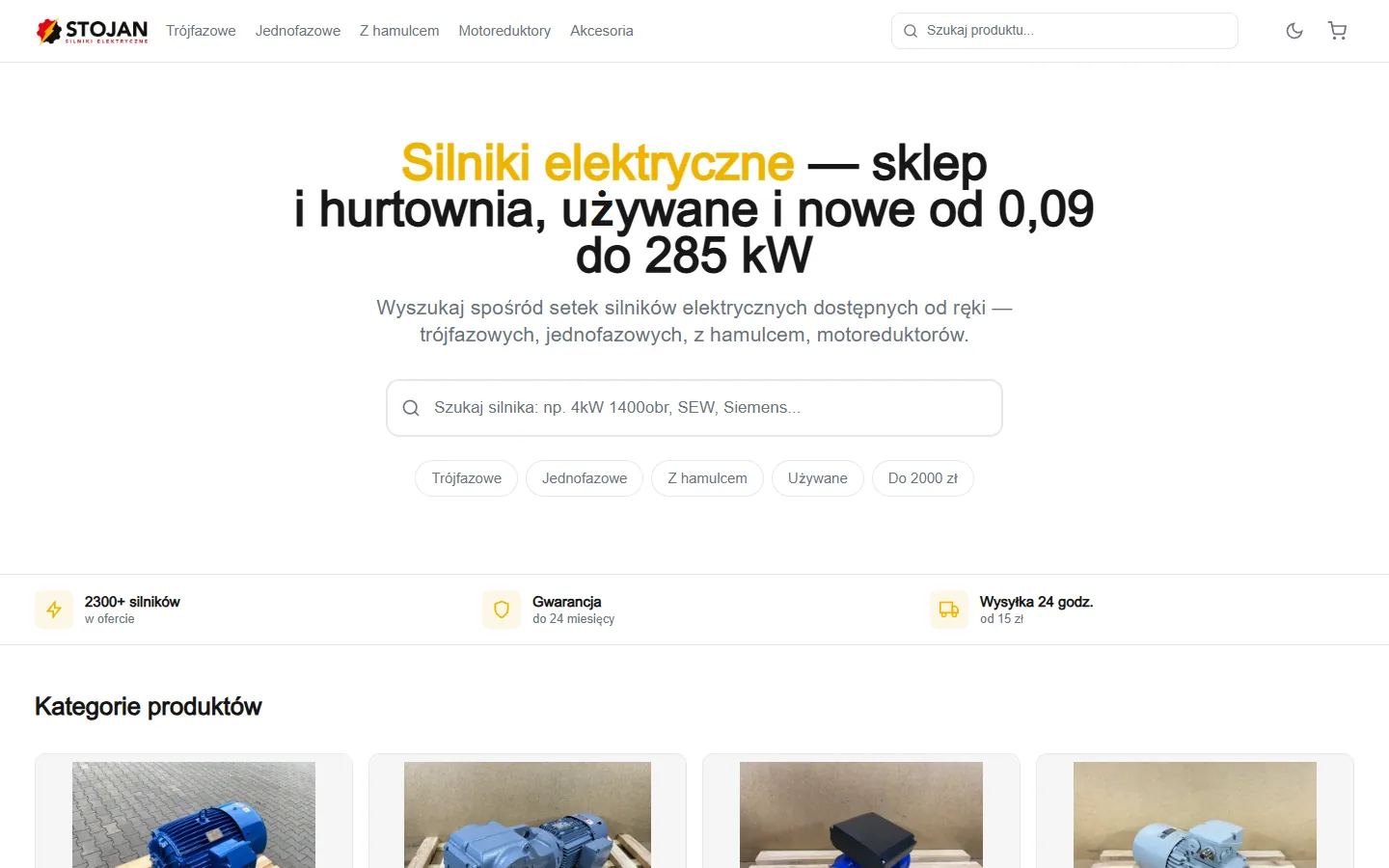
The catalogue holds several thousand electric motors differing in power, RPM and build, and the previous WooCommerce store matched queries only against product names. A client who knew the parameters had to click through the categories by hand.
What I built
a catalogue of 2300+ items from 0.09 to 285 kW, with filters for power, RPM, build and price
a search box that reads technical queries: power, RPM, symbol, manufacturer
two-way synchronisation with Allegro — one stock level in two places
Stripe payments: card, BLIK, Przelewy24 and cash on delivery
a Google Merchant feed, in-house sales analytics, mailing through SES
two extra topical sites that bring in Google traffic and update themselves
The result
After the migration, sales grew by 40%. Over the last 90 days the store collected 6411 search visits from 327 thousand impressions.
Made-to-measure furniture fronts — order form model
The task
A furniture front is made to individual dimensions: a decor from four board manufacturers' catalogues, a frame width, plus glass, a mirror or a 45° cut. The price emerges only from those parameters, so every enquiry used to end in a string of e-mails.
What I built
a configurator that walks the client through the order step by step
a decor catalogue from four board manufacturers, grouped by finish
a dimension table: width, height and quantity for each front separately
a simplified variant: the client gives just the surface area and gets an indicative quote
net and gross prices recalculated live from the price list, with a 4 m² logistics minimum
an order form with a complete data set: contact, address, VAT ID, notes
The result
The enquiry now arrives ready for quoting: with dimensions, a decor and an indicative amount the client has already seen. The whole e-mail exchange shrank to a single submission.
You can come with a product list on a sheet of paper, with a finished
graphic design, with your own vision and a list of features, or with
a store that already sells. Every one of these starting points works —
from there I run the project and hand over a store that can take
orders right away.
What you bring
a product list — a spreadsheet, a wholesaler's file, a PDF catalogue or a sheet of paper
a finished graphic design or your company's brand materials
your own vision and a list of features the store should have
a store that already sells and needs a move or an upgrade
just an idea, with no materials yet
What you get
a store running on your own domain
your stock entered with prices, categories and quantities
product and category descriptions written for search and for the buyer
payments, shipping and documents ready for selling
a panel where you run the store without my help
training and a recording you can come back to
The store is built with three things in mind from the start: that
Google understands it and ranks it high, that it opens fast on
a phone, and that you can run it on your own.
Fit
A store fitted to your trade.
Before anything gets built, I learn your trade and analyse your
business: how clients recognise the goods, how the variants differ,
how you calculate the price and where availability comes from. Below
are the solutions I add when your sales call for them.
A search box tuned to your stock
Clients search by what matters to them: size, weight, purpose, composition, colour or a catalogue symbol. I tune the search box to those words, so the buyer lands on the right product straight away.
Fewer “do you have…” phone calls, more orders placed unassisted.
Made-to-measure products with a live quote
If you sell things made to order, the client assembles the product step by step and sees the amount along the way. What reaches you is a finished order with the full data needed for a quote.
Quoting stops eating a day of work, and the client gets an answer right away.
Selling to businesses
Net prices, discounts tied to a specific account, individual price lists, deferred payment and a one-click repeat of an earlier order.
A regular client places the order alone, with their own price already in the cart.
Availability that matches the warehouse
The store pulls stock levels from your warehouse software or from your wholesaler, and keeps them in step with Allegro.
An end to selling stock that is off the shelf already.
Scope
What's included.
Catalogue and search
product pages with photos, parameters and availability
filters for the parameters that matter in your trade
a search box that understands technical queries
categories and product variants
a configurator when the product is made to measure
Sales and settlement
a cart or an order form, depending on the sales model
payments: card, BLIK, Przelewy24, cash on delivery, deferred bank transfer
net and gross prices, discounts and individual price lists for regulars
invoices and documents sent automatically
delivery costs and dates calculated from weight or size
Integrations
Allegro — the same stock level in the store and on the auctions
your warehouse software or a supplier's wholesale feed
accounting and invoicing systems
Google Merchant Center and product campaigns
transactional mailing and order status notifications
Server and upkeep
a server, a certificate and configuration sized for your traffic
daily backups and monitoring every few minutes
loading speed set at the design stage
GDPR-compliant cookie consents
a panel where you add products and see orders yourself
Copy
category and product descriptions written for the buyer
texts for the information pages: delivery, returns, contact
editing and proofreading of materials you already have
blog posts built around your clients' questions
product photos prepared for the web
SEO
addresses, titles and headings arranged around buying phrases
price and availability data readable for Google
a sitemap, redirects and orderly categories
loading speed that Google factors into its ranking
Search Console and Analytics connected from day one
Panel
A panel for running the store.
The store comes with a panel where the whole sales operation lives.
I design it as carefully as the store itself: everything is described
in the words of your trade and arranged so the everyday tasks sit
within reach. Your employee will handle it without trouble too, and
if you prefer to hand it over — I run the store for you as part of
ongoing care.
Orders in one place
New orders, statuses, shipping addresses and tracking numbers. A status change sends a message to the buyer on its own.
Products, prices and stock
Adding and editing items, photos dragged in with the mouse, prices and availability. Changes show in the store immediately.
Promotions and discounts
Time-limited reductions, discount codes, prices for regulars. The price history keeps itself.
How many orders, for how much, what sells best and on which days. With nothing exported to a spreadsheet.
Works on the phone
You can accept and dispatch an order from your phone, standing in the warehouse. The panel is built as carefully as the store itself.
Integrations
External API integrations.
Below are the connections I configure most often. If your system is
missing here, it can usually be connected through an API or file
exchange — I check that at the quoting stage. How such an integration
looks from the inside, I described using the motor store as the
example:
synchronising Allegro with your own store.
Marketplaces and comparators
Allegro
BaseLinker
Ceneo
Opineo
Google Merchant Center
Facebook and Instagram
Payments
Przelewy24
PayU
Tpay
Stripe
PayPal
BLIK
cash on delivery
deferred terms for businesses
Shipping
InPost and parcel lockers
DPD
DHL
UPS
GLS
Poczta Polska
in-person pickup
Warehouse and accounting
Subiekt GT and nexo
Comarch ERP
Fakturownia
InFakt
wFirma
a price list file from your wholesaler
Analytics
Google Analytics
Google Tag Manager
Search Console
cookie consents
Meta Pixel
newsletter
Platforms
A ready-made platform or a custom build.
I know all the popular store systems and can move a store off them or
extend one. My own builds are custom, because with a parameter-heavy
catalogue, a configurator and warehouse integrations that gives
a freedom the ready-made systems can't match.
W
WooCommerce
The most popular store on WordPress. Cheap to start, comfortable with a small catalogue. With a few thousand products and plugins from assorted authors it starts to slow down.
P
PrestaShop
A feature-rich store straight after installation. Changes beyond the standard usually call for paid modules.
S
Shopify
A monthly subscription and a quick start, in exchange for limits on what can be changed and a commission on sales.
M
Magento
A system for very large catalogues and cross-border sales. Costly to maintain and demanding at every change.
my proposal
A custom build
A store written for your stock: a search box that understands
your trade's parameters, a configurator that calculates from your
price list, integrations matched to your systems. You pay once
for the store, and all the sales and every feature stay yours.
Astro · Fastify · PostgreSQL · AWS server
Data and visibility
You know what happens in the store, and why.
I configure the analytics together with the store and set it up for
sales: from day one you can see which products and which visits end
in an order, and decisions about the next steps rest on numbers.
You see what sells
From day one you have the full numbers: which products move, what the average order is worth and what keeps coming back in returns.
You know where clients come from
Search Console shows which questions Google surfaces your store for, and which of them actually end in an order.
You see where buyers stop
The path from arrival to payment laid out in steps. If people drop off at delivery or at variant choice, it shows immediately.
Growing your visibility as we go
I can keep working on the store's Google presence: code fixes, content and links from my own network of topical sites. The numbers from Search Console decide the next steps.
Add-on
A blog that writes itself.
Before someone buys, they first ask Google things like "which
motor for a compressor" or "how does an acrylic front differ from
a lacquered one". The autoblog answers those questions in your
store and brings the buyer in before they start comparing prices.
we agree on topics and frequency, then everything runs on its own
posts are built around questions your clients really type in
each article with an illustration publishes itself in the store and leads to the products
you can edit or hold any post from the panel
the articles remain yours and keep working for years
Migration
Want to extend or improve your store?
I rebuild stores that already run, keeping everything you have
earned: the stock, the clients and the place in Google's results.
Your stock
Products, photos, categories, client data and order history move to the new store in full.
Links that already work
Every old address redirects to its counterpart in the new store, so a client coming from a bookmark or an old link lands where they meant to.
Your place on Google
I carry over the category layout, headings and descriptions so Google recognises the same store and leaves it where it was.
Switch-over day
The new store runs earlier at a temporary address visible only to us. The switch takes a few minutes and the old store stays as a fallback.
The motor store went down this road from WooCommerce, and after the
migration sales grew by 40%. The growth came from clients finally
finding the goods they came for.
Regulations
Legal compliance as standard.
Selling online follows its own rules. Everything below I prepare
together with the store, so from day one you sell with peace of mind
and a complete set of documents.
Terms of service and privacy policy
The store gets a complete set of documents matched to what you sell and to whom, including the returns and complaints clauses.
GDPR
Consents collected separately for each purpose, access to one's own data and deletion on request, a data processing agreement.
Omnibus Directive
With every promotion the store shows the lowest price of the last 30 days on its own and keeps the price history.
Consumer law
Fourteen days to withdraw, a returns form, clear information about delivery costs before payment.
Cookie consents
A consent banner wired into Consent Mode, so analytics counts what the client actually agreed to.
Security
An SSL certificate, daily backups, two-factor login to the panel.
Toruń
Online stores for companies in Toruń.
I design and build stores from Toruń, from an office at
Gardzielewskiego, so for a local job I drop by the warehouse and see
the goods on site. With a large assortment or a made-to-measure
configurator, an hour spent at the shelf can be worth more than
a week of e-mailing about what the stock looks like.
A Toruń store in the portfolio
Mekra.pl is a Toruń company producing made-to-measure furniture
fronts. The order takes shape in a step-by-step configurator, and
the net and gross price recalculates live from the price list.
I keep running the store after launch.
Building a store starts with understanding what you sell and how
clients ask for it. In Toruń we do that at a table, in a quarter
of an hour. Then I work remotely and show progress at a live
address.
Selling beyond Toruń
I build the store for sales across the whole country: shipping,
payments, Allegro and the warehouse integration work the same for
a client from Toruń as for one at the other end of Poland.
I also run stores remotely in Bydgoszcz, Inowrocław, Grudziądz,
Włocławek, Chełmno, Świecie and beyond the region. A regular company
website is covered under
website development.
Process
From first conversation to the first order.
011 day
Conversation
What you sell, how clients search for it and what eats the most time in order handling today.
022–3 days
Quote
The scope itemised, a price and a deadline. One amount for the whole job.
031–2 weeks
Design
The catalogue layout, the product page and the order path. You approve the look before any code is written.
044–8 weeks
Build
From the first week the store runs at a temporary address — you log in and check progress as it happens.
051–2 weeks
Stock and tests
Catalogue import, integrations, trial orders and live payments.
06ongoing
Launch and care
Domain switch, redirects, monitoring. Then ongoing work: fixes, new features, backups.
After launch
You end up with a working store and the knowledge to run it.
Hands-on training
A meeting where I walk you through the panel on your own products and orders. The recording stays with you, so a new person at the company can watch it too.
Documentation and access
All logins, passwords and addresses in one document. The code goes to a repository you have access to.
A month of support included
For the first month after launch I fix and explain as much as needed, within the price of the build.
Care and growth
Server, backups, monitoring and updates in a subscription from 400 zł a month. New features get added when they are needed.
Price
A store starts at 4999 zł net.
That is the starting price for a store with a catalogue, a cart,
payments and a panel — set up, filled with stock and launched on
your own domain. I give the exact amount after we talk, once
I know the catalogue size and the list of integrations.
from 4 999 złnet, one-off
What affects the price:
Catalogue sizeA hundred items and five thousand mean different work on import, filters and performance.
ConfiguratorPrice list rules, variants and product options form a separate module to build.
IntegrationsAllegro, warehouse, accounting — each connection is its own piece of work.
RebuildMoving an existing store while keeping its addresses and Google positions.
CopyI can write the category and product descriptions, or you deliver your own.
Graphic designExisting brand materials speed things up; a design from scratch is a separate stage.
On top of that comes upkeep — server, backups, monitoring and updates
— from 400 zł a month. The domain and the certificate are included in
that amount.
Calculator
How much will your store cost?
Tick what you need. The amount updates as you go and shows what each
item adds. This is an indicative estimate, prepared at the same rates
I use to quote real projects.
Questions
The questions I hear most often.
How long does a store build take?
A simple catalogue with no integrations — around six weeks. A store with a configurator or with Allegro and warehouse synchronisation — two to four months. I give the deadline together with the quote and I keep to it.
Will I be able to add products myself?
Yes. You get a panel where you add and edit products, categories, prices and photos, and handle orders. If your stock lives in warehouse software, it is usually better to connect it and let the quantities update themselves.
I already run a store on WooCommerce. Will I lose my Google positions?
With a properly done migration the positions stay. Every old address gets a redirect to the new one, and the structure and structured data are recreated. The motor store went down this road, and after the migration sales grew by 40%.
What do you build stores on?
On my own code: Astro and Fastify on an AWS server, data in PostgreSQL. That gives me full control over the search box, the configurator and the speed — the three things that decide sales the most.
What about hosting and upkeep after launch?
The store runs on a server I set up and look after: daily backups, monitoring every few minutes, certificates and updates. Upkeep is a subscription, from 400 zł a month.
Will the store work on a phone?
Yes, and that is usually where most of the traffic comes from. I design the filters and the product page for thumb use on a narrow screen.
Will you help with traffic after the launch?
SEO is built into the store's structure from the start: addresses, structured data, speed and a sitemap. On top of that I run product campaigns and the Google Merchant feed, and I show the results in Search Console and Analytics.
Who owns the code and the data?
You do. You get the code repository and full server access, so you can move the store elsewhere at any time.
Do you build online stores for companies in Toruń?
Yes, I am based in Toruń, at Gardzielewskiego. For a local job we meet on site and I see the stock in the warehouse — with a large catalogue or a made-to-measure configurator that shortens the arrangements by weeks. The Toruń store I built and still run is Mekra.pl, selling made-to-measure furniture fronts. Beyond Toruń I work remotely across Poland.
How much does building an online store cost?
From 4999 zł net for a store with a catalogue, payments and shipping. A meeting in Toruń is included in that amount. I give the exact price after we talk, once I know how much stock you have, what the warehouse looks like and what the store needs to connect to.
Related services
What else I do.
Projects rarely stop at one thing — here is the rest of what I do, each with its starting price.
A few sentences about what you trade in and roughly how many products you have are enough. I reply with a quote, a timeline and a suggestion where to start — usually the same day.