First the file, then the sentence
The order is the reverse of a typical AI tool. The publication is downloaded and read in full first, and the citation is built only from what actually appears in it.
My own product: you give it a topic and get verified sources with a quote, a page number read from the printed copy and a link to the publication — ready to paste, along with a formatted bibliography. Below: where it came from and what was hardest about building it.
Problem
A paper without sources is simply incomplete. A paper with sources that cannot be found undermines everything around them — including the parts that were perfectly fine.
A supervisor, a reviewer, an editor. One reference that cannot be found is enough to cast doubt on everything else in the work.
And they do it convincingly: a plausible title, a real author's name, a journal that actually exists, a year that fits. Except the article itself was never written.
Even when the publication is real, the page given often has nothing to do with the quoted passage. It is a second layer of the same problem, and a harder one to catch.
Tracking down each reference, opening the file, finding the sentence and comparing the page number takes more time than generating the whole paragraph did.
Solution
A typical tool generates text and staples citations onto it. Here it works the other way round — the publication is downloaded first, the quote is taken from it, and the citation is built at the end, out of things that have already been read.
The order is the reverse of a typical AI tool. The publication is downloaded and read in full first, and the citation is built only from what actually appears in it.
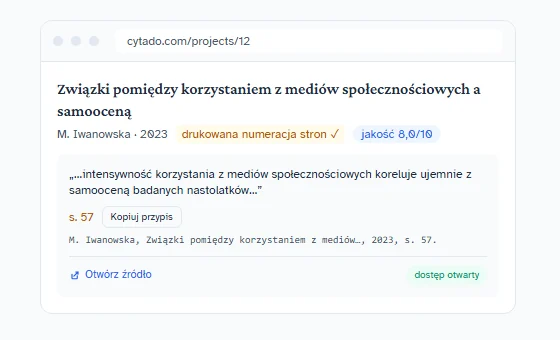
The number printed on the page rather than the file's sheet index — the one a reviewer will see in the paper edition. It was successfully read on 159,814 of 178,545 pages.
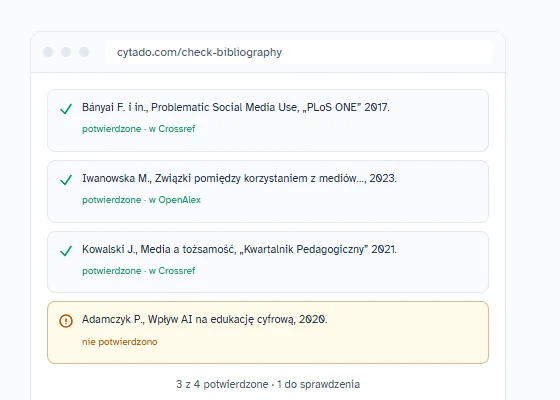
The citation leads to a specific document and a specific page, so whoever checks it reaches the source in seconds. When verifying someone else's bibliography, the tool marks entries as confirmed or unconfirmed — it never rules that something is fake.
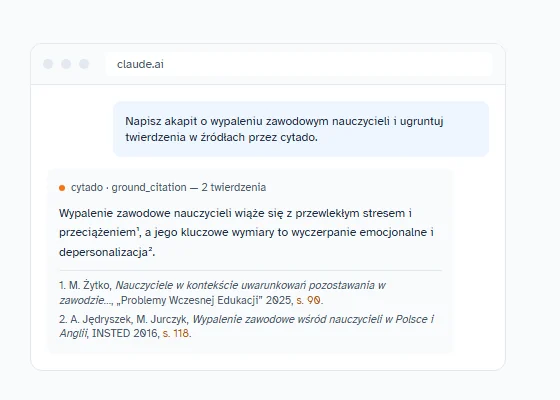
The web app, a browser extension, add-ins for Word and Google Docs, a WordPress plugin, and an MCP server that lets an AI assistant draw on the same corpus.
From the product
Three views. The first shows the result, the second what happens when something cannot be confirmed, the third the same corpus used inside an AI assistant.
What was hard
What this means for you
In most companies the biggest trouble with a language model is that nobody knows where an answer came from. Cytado is proof it can be built differently: every sentence points to a document and a place in it, and the system is allowed to say it does not know.
If someone at your company has to manually check whether an answer is backed by documents — contracts, procedures, technical documentation — the same pattern carries over. Write to me and describe how it works today.
Related services
Cytado is an AI deployment grounded in real documents. Below is the rest of what I build for companies, with starting prices.
Let's talk
Describe the documents you work with and who checks today whether an answer is backed by them. I will tell you whether it can be grounded so that every sentence points to a place in a file, and roughly what a single answer would cost.